
24/7 Intelligent Voice AI: Automating Inbound Customer Care & Seamless Handoffs
Scaled support capacity to 10,000+ daily calls with sub-2-second latency, 98% handoff precision, and 65% operational cost reduction.
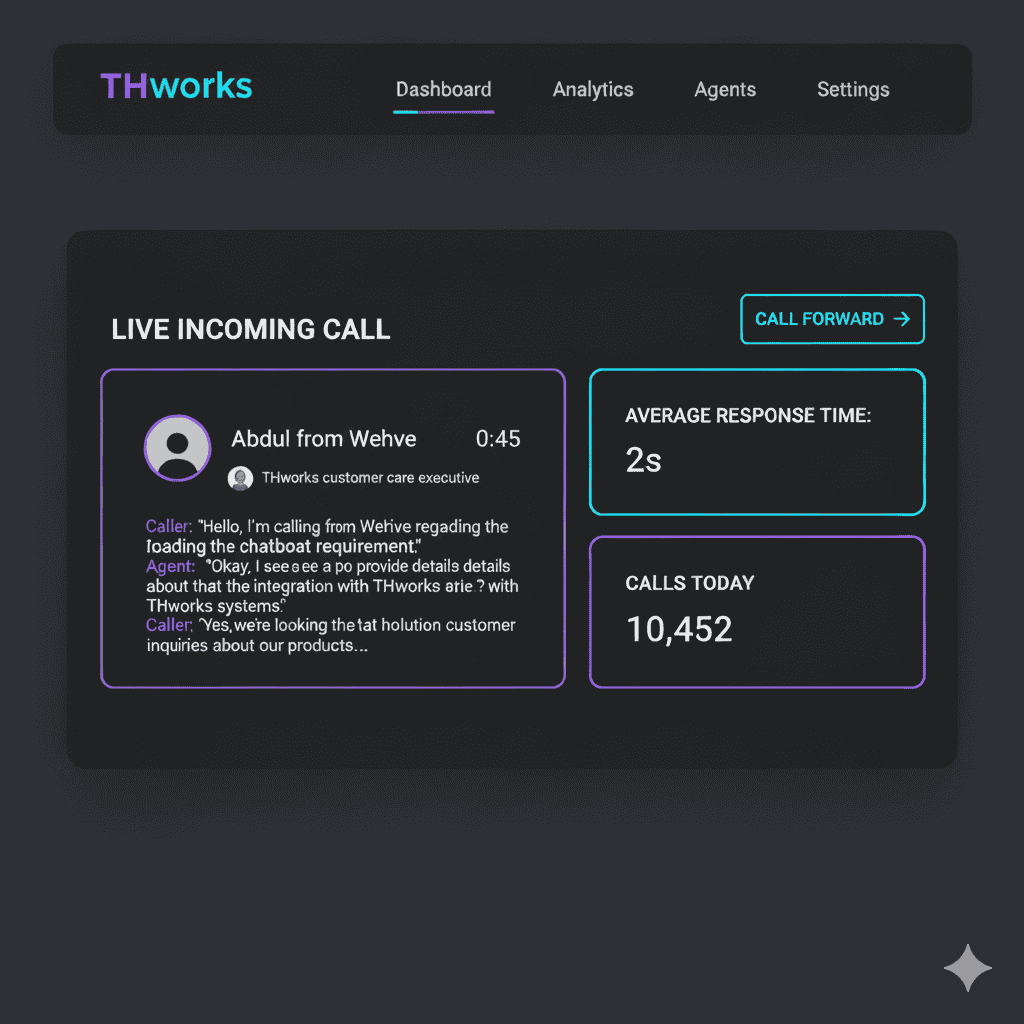
THWORKS built a production-grade Voice AI Assistant that handles 10,000+ inbound customer calls daily with sub-2-second response latency. The system automates appointment booking, FAQ resolution, and CRM updates using real-time STT/TTS and LLM-powered intent recognition. When queries exceed AI capability, a contextual handoff mechanism transfers calls to human agents with a full interaction summary — achieving 98% handoff accuracy and cutting operational costs by 65%.
The Challenge: 35% Call Abandonment During Peak Hours
The client's support center was losing 35% of inbound calls during peak hours due to limited human agent availability. A 24/7 staffing model was financially unsustainable, and agent fatigue caused inconsistent data entry in their CRM — resulting in duplicate records and missed follow-ups that cost an estimated $2.1M annually in lost revenue.
For an enterprise processing thousands of appointment-based inquiries daily, every abandoned call represents lost revenue. The client needed more than a basic IVR menu tree — they required a natural-sounding AI capable of understanding caller intent, checking real-time availability across 200+ service locations, and recognizing precisely when a human agent was needed to close high-value leads.
Our Solution: Streaming-First Conversational AI Pipeline
We deployed a modular Conversational AI pipeline built on a 'Streaming-First' architecture. The system chains ultra-fast Speech-to-Text (STT) for real-time transcription, a fine-tuned LLM with RAG for intent recognition and tool-calling, and high-fidelity Text-to-Speech (TTS) — all connected via WebSocket-based audio streaming to bypass traditional request-response overhead.
To hit the sub-2-second latency target, we eliminated HTTP polling entirely in favor of full-duplex WebSocket connections. The AI was integrated directly with the client's CRM and scheduling APIs, enabling live availability lookups and appointment bookings without human intervention — reducing average handle time from 8 minutes to under 60 seconds for routine queries.
Key Technical Decisions
Hybrid Semantic Routing: Built a real-time decision engine monitoring sentiment drift and intent confidence scores to trigger human handoffs before customer frustration peaks — not after.
Contextual State Transfer: Developed proprietary middleware that passes full transcripts and extracted structured data (caller name, ID, issue category, sentiment score) to the agent dashboard during transfer — eliminating the 'please repeat yourself' problem.
Noise-Resistant STT Pipeline: Fine-tuned speech recognition models on 50,000+ hours of mobile call audio to filter background noise common in real-world calling environments, improving transcription accuracy by 23%.
Results: From 8-Minute Wait Times to Instant Resolution
Before
Human agents overwhelmed by routine FAQs. 8-minute average wait times. Zero support coverage between 8 PM and 8 AM. 35% call abandonment rate during peak hours.
After
Instant 24/7 response across all time zones. Routine queries resolved in under 60 seconds. Human agents focused exclusively on complex, high-priority escalations. Call abandonment dropped to under 3%.
Technology Stack
"THWORKS didn't just give us a chatbot — they gave us a digital workforce. Our customers don't even realize they're talking to an AI until the booking confirmation arrives. The latency is practically non-existent, and our agents finally have time for the conversations that actually need a human touch."
Frequently Asked Questions
Common questions about this project and our approach.
When the AI detects a complex issue or negative sentiment drift, it initiates a SIP transfer to the next available human agent. Simultaneously, the agent's screen displays a real-time summary including the full transcript, extracted entities (caller name, issue category, account ID), and sentiment score — so the customer never has to repeat themselves.
Related Case Studies
Build Your Voice AI Assistant
Let's discuss how we can solve your technical challenges with the same precision and impact.
Build Your Voice AI Assistant